Fourteen Weeks, Five Peaks
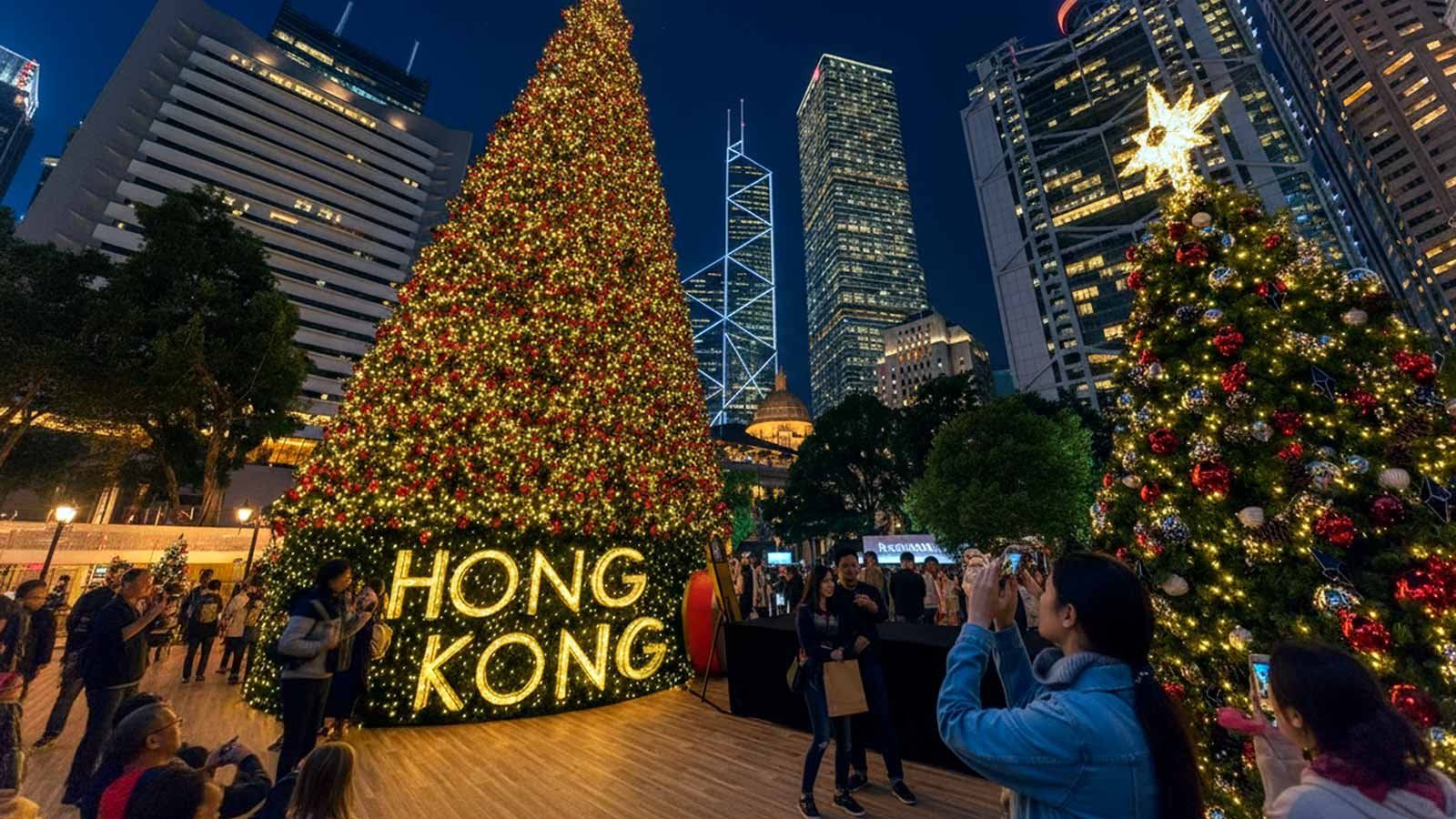
Hong Kong’s festive season gets talked about as though it were one event. It isn’t. It is five overlapping periods running back to back from early November to the middle of February, each with its own demand profile and each asking something different of your team. Fourteen weeks of sustained pressure with sharp spikes inside it, rather than a single Christmas rush.
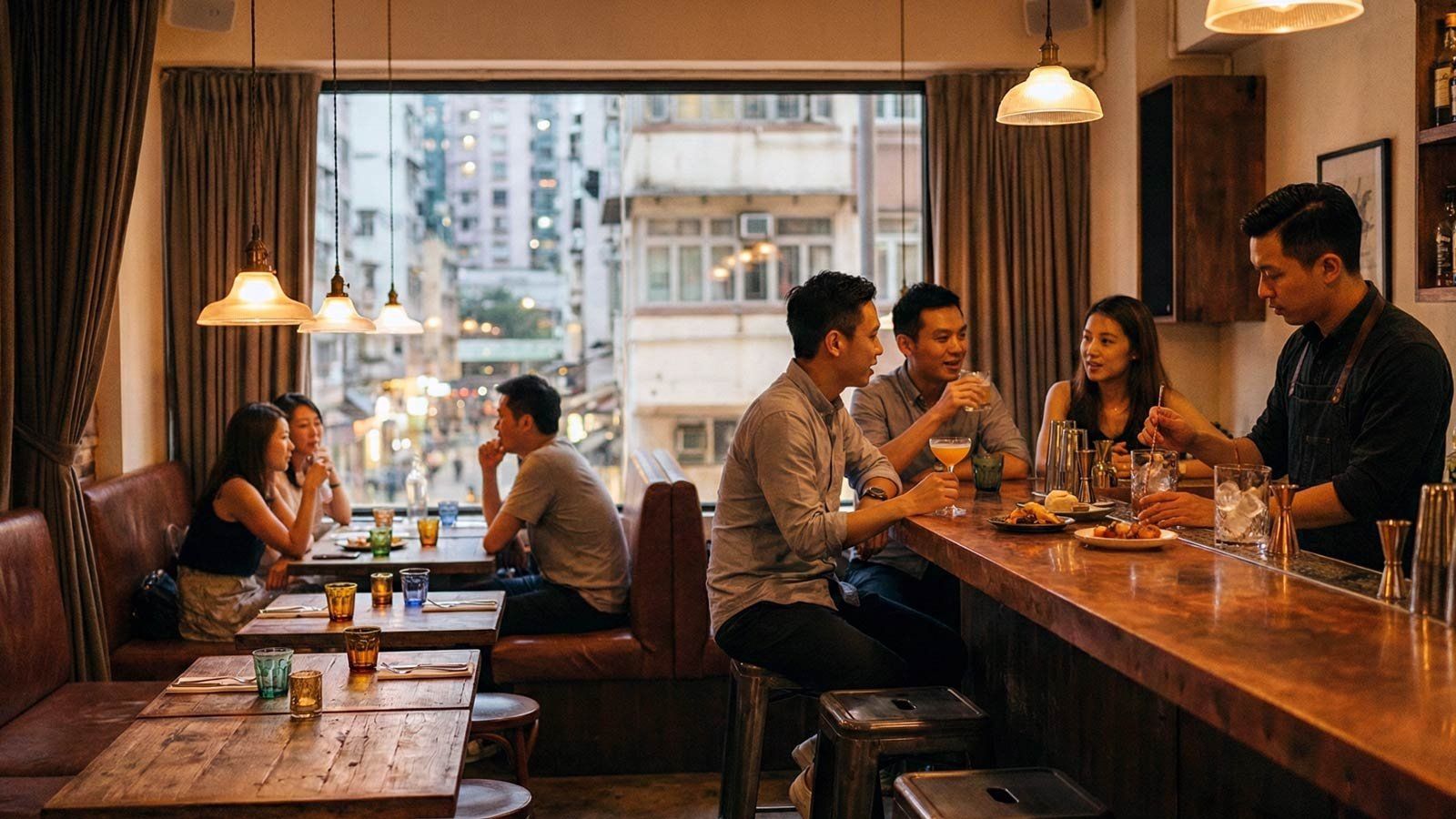
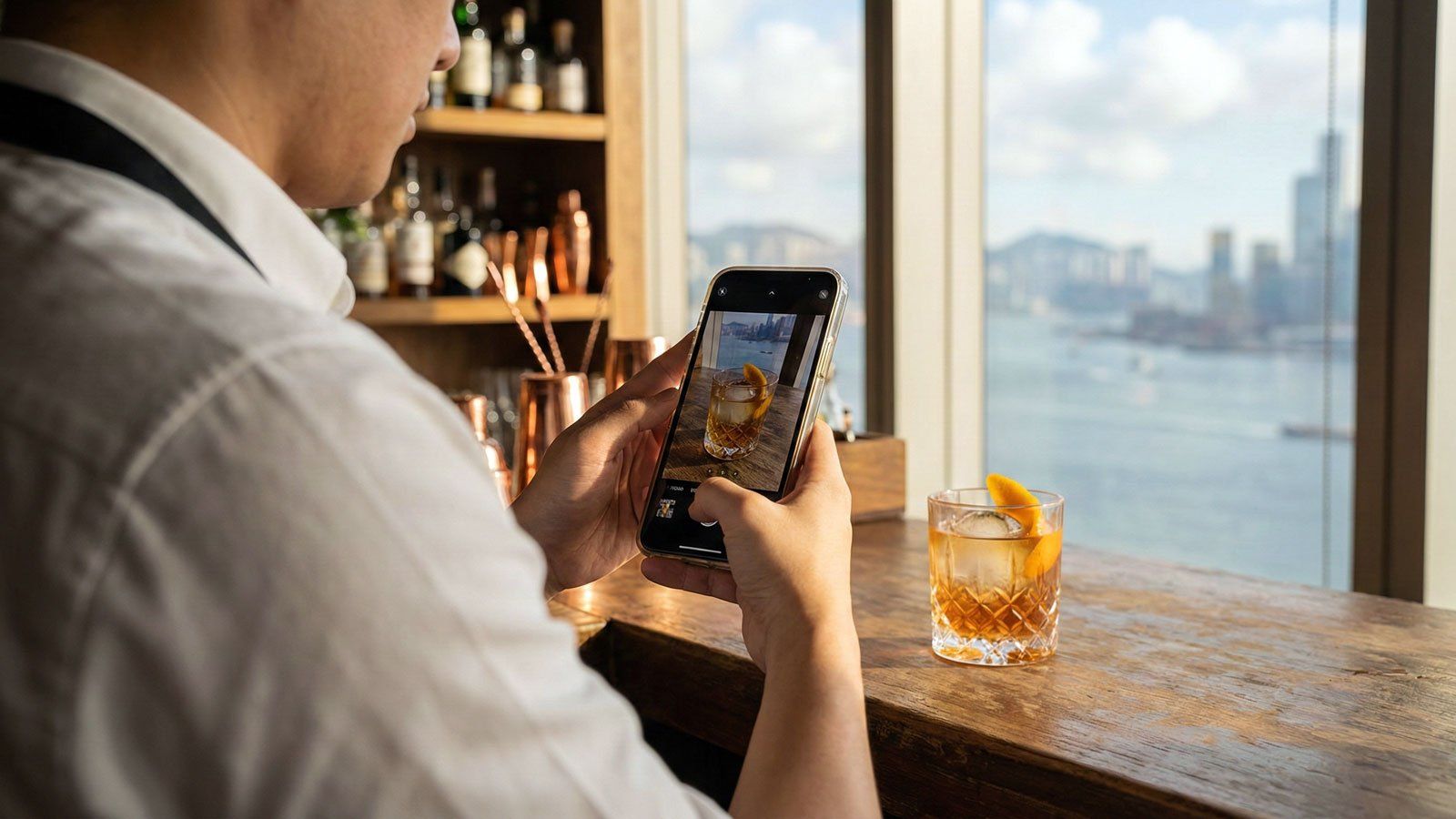
It opens with trade fair season. From the fourth of November onwards the Convention Centre and AsiaWorld-Expo run almost continuously: optical, wine and spirits, beauty, logistics, design, construction. Kai Tak and AsiaWorld-Expo add stadium concerts through the same weeks. This is midweek business demand, and it lands on hotel restaurants, on bars in Wan Chai and Central, and on anything within reach of the two exhibition venues.
Retail season builds from mid-November as WinterFest and the mall activations begin, and holds through to the New Year. December is reliably Hong Kong’s strongest retail month, worth HK$35 billion last year. Christmas Eve and Christmas Day then carry the heaviest single-day trading of the calendar, and New Year’s Eve compresses an enormous amount of demand into one night.
January quietens, but only briefly. The Chinese New Year run-up starts in the middle of the month, with reunion dinner bookings opening three to four weeks ahead. Chinese New Year falls on Saturday 6 February 2027, giving Hong Kong a four-day holiday through to Tuesday the ninth. Reunion dinner on the eve is the single biggest Chinese festive trading night of the year, every bit as intense as Christmas Eve. Mainland China’s Spring Festival runs longer than Hong Kong’s, which shapes visitor flows on either side of the local dates.
The Demand Signals Are Good
The macro picture heading into this season is the most encouraging it has looked in several years, and it deserves setting out properly, because the headlines have not always reflected it.
Retail sales have now grown year-on-year for fifteen consecutive months, a streak running since May 2025. Across the first seven months of 2026, retail sales value rose 8.9 per cent. Visitor arrivals hit 31.22 million by the end of July, up eleven per cent, with the Tourism Board projecting 53.8 million for the full year. Hotels are running at 86.7 per cent occupancy and achieved room rates of HK$1,297, both ahead of last year.
The investment signal is louder still. Hong Kong’s F&B sector took 155,000 square feet of new leasing in the second quarter alone, more than double the first, bringing the half-year total to 230,000 square feet. That is record activity. Operators are moving because F&B rents have stayed soft whilst the rest of the market recovered, and the brands taking that space are backing their judgement with real capital.
Dairy Queen is the most visible example. It returns to Hong Kong this November after nearly five decades away, with a flagship at One Causeway Bay, a second site at The ANGLE in Kwun Tong, four stores confirmed for the fourth quarter, and a stated ambition of sixty outlets by 2034. It arrives alongside a broader wave: Black Sheep Restaurants has opened repeatedly through 2026, Maxim’s revived its Palace format at MOKO, and Kai Tak has become the densest new dining precinct in the city, with more than seventy restaurants in the retail pavilion alone.
Why It Will Not Land Evenly
The demand is real. It is also not arriving everywhere at once, and that is the part worth planning around rather than being surprised by.
Restaurant receipts rose just 0.4 per cent in value in the second quarter, whilst volume actually fell. Underneath that flat headline sits a clear split. Full-service Chinese and non-Chinese restaurants both grew. Fast food fell 1.5 per cent and bars fell 3.8 per cent. Net restaurant licences have declined for the first time since 2018. Growth in visitor numbers and retail spending is not translating automatically into growth for every venue.
Part of the explanation sits across the border. Hong Kong residents made 87.1 million outbound trips through land ports in 2025, up from 53.6 million two years earlier, and the pattern has held through 2026. Weekend and casual trade has moved north, and it looks structural rather than cyclical. That is precisely the trade fast food and bars depend on.
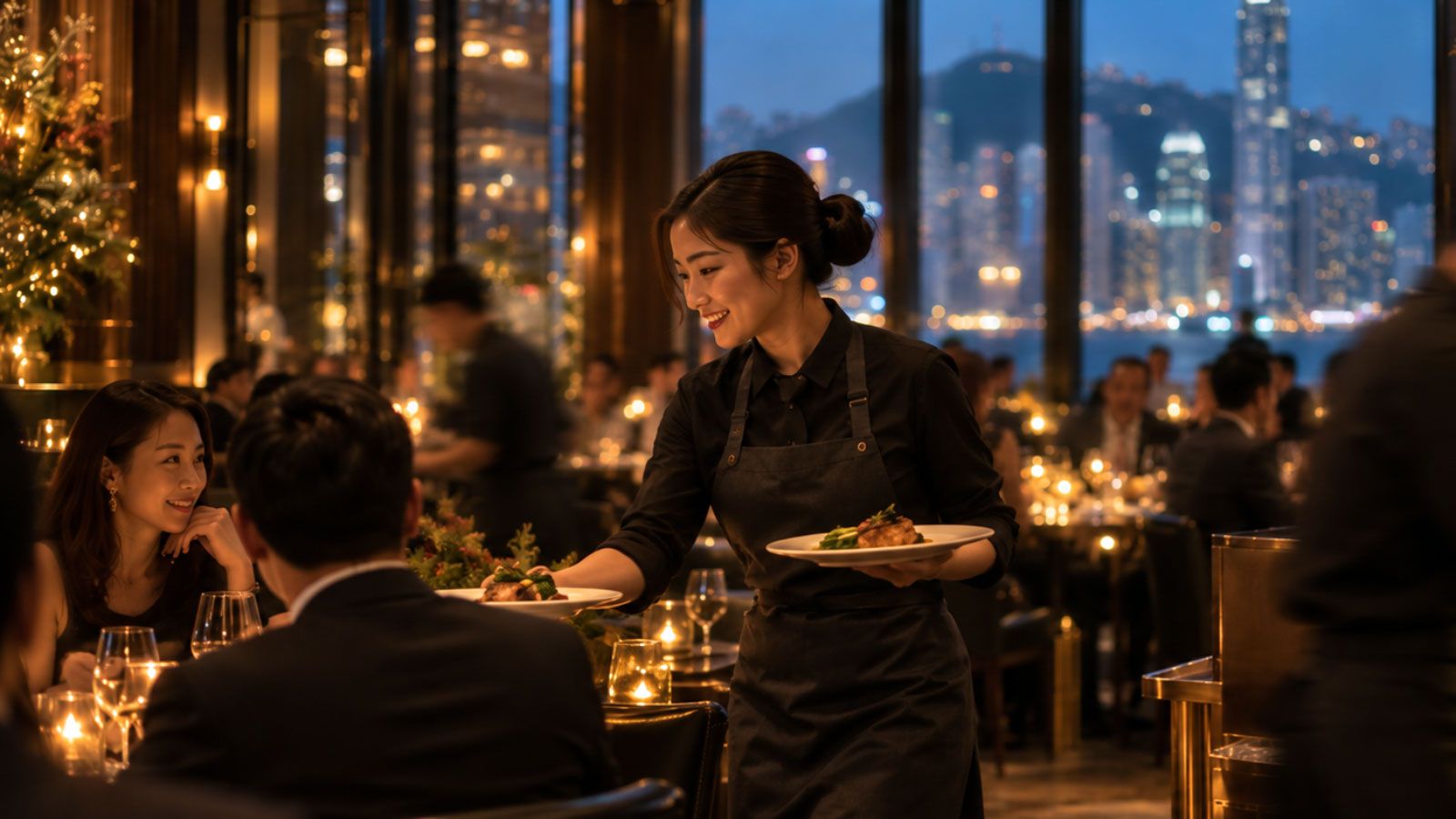
What remains is a market where the upside concentrates in venues offering something worth choosing deliberately. Visitors are spending more on culture and experience and less on straightforward shopping, and the Tourism Board’s own reading of the data says the same. Delivering that consistently, across fourteen weeks of peak trading, is a staffing question long before it is a menu question or a marketing one.
Hong Kong Does Not Have a Staffing Shortage
This is the finding that should change how operators approach the season, and it runs against what almost everyone assumes.
Hong Kong’s food and beverage sector is running at roughly six per cent unemployment and, at the same time, a vacancy rate of around five per cent. Those two numbers should not sit together. The government’s own analysis, presented to the Legislative Council in June, puts the gap down to a mismatch in skills, working hours, and location rather than any absolute shortage of people, and notes that unemployed F&B workers skew heavily towards the over-45s.
The evidence for a matching failure rather than a supply failure is stark. Between September 2025 and May 2026, F&B employers running the mandatory local recruitment process attached to imported labour applications advertised nearly 4,100 vacancies. Those vacancies produced around 720 interview attendances. Of 234 offers made, twelve were accepted. A 5.1 per cent acceptance rate is not the signature of an empty labour market. It is the signature of a process failing to reach the right people, with the right roles, on terms they will say yes to.
That distinction matters commercially, not just analytically. If the constraint were real scarcity, the only levers would be paying more or importing labour, and both are slow and expensive. Because the constraint is matching, the levers are different and a good deal cheaper: reach candidates who are already in the market, be specific about shifts and districts instead of advertising generically, and reply quickly enough that a good candidate has not accepted something else by the time you get back to them.
Peak season sharpens all of it. Casual hospitality rates in Hong Kong currently run around HK$70 to HK$100 an hour for front of house, and HK$100 to HK$115 for festive kitchen work, against a statutory minimum of HK$43.10. Market rates, not the legal floor, are what operators compete on, and employers are already attaching premiums to the highest-demand dates and paying attendance bonuses for reliable coverage.
The Chinese New Year Problem, and the Clock
Chinese New Year is the hardest staffing period in the Hong Kong calendar, and it is hard in a specific, predictable, entirely plannable way.
Staff travel. Many casual and part-time workers never come back. A 2025 survey of 950 catering workers by two Hong Kong labour unions found 52.5 per cent reported losing their jobs after Lunar New Year, and that the share of employers reporting use of imported labour rose from 24 per cent before the festival to 72 per cent afterwards. That churn is now under active scrutiny: the Secretary for Labour and Welfare has stated that employers found to have dismissed local workers after importing labour face administrative sanctions.
The rules tightened in June 2026 as well. Catering employers importing kitchen or floor staff must now hold a three-to-one local-to-imported ratio, up from two-to-one, calculated across the whole department. They must also run a six-week local recruitment campaign and attend a Labour Department job fair every fortnight. Miss a fair and the application is rejected automatically.
Do the arithmetic and the timing gets uncomfortable. Six weeks of mandatory recruitment plus processing puts realistic lead time at six to eight weeks before the need date. For a holiday starting on 6 February, that means beginning before Christmas, in the middle of the period when every operator is already flat out. Local casual hiring moves faster, typically three to six weeks ahead, which puts the Christmas recruitment window in early November and the Chinese New Year window in early January.
One piece of timing works in your favour. Hong Kong schools break for winter from around 21 December to 3 January, and again for roughly a week around Chinese New Year. Those are the two points in the year when student and part-time availability is at its widest, and they line up almost exactly with the two highest-demand periods of the season.
What This Season Rewards
Hong Kong hospitality is heading into its strongest fourteen weeks with real fundamentals underneath it. More visitors, more spending, more investment, and a calendar that holds demand up from the first week of November straight through to the middle of February.
What it rewards is preparation over reaction. The operators who take the most out of this season will be the ones who worked out in October what each of the five phases needs, who know which dates want double coverage and which want the full team, and who started recruiting on a timeline that reflects how long hiring actually takes rather than how long they would like it to take.
And here is the encouraging part. The staffing constraint is not the wall it gets described as. There are people in this market looking for hospitality work right now. The difficulty is reaching them with the right role, in the right district, on the right shifts, fast enough to matter. That is a solvable problem, and solving it is exactly why we built Shift Happens.
If you are planning your festive season staffing, now is the moment rather than December. You can post roles, manage applications, and run casual shifts across all your outlets from the web platform or from ShiftCMS Pro on your phone. Register or sign in at shifthappens.app.