
Hong Kong's F&B sector is running out of hours before it runs out of candidates.
The industry has lost tens of thousands of workers over the past decade, whilst the hiring process that replaces them still runs largely on manual triage. Operators need leverage, not another job board.Shift Happens has rolled out a complete AI toolkit covering both sides of the marketplace.
Nine features span the recruitment journey, from the moment an employer starts drafting a listing to the moment a candidate sits down for interview preparation.On the employer side, the stack removes friction from posting and shortlisting.
Smart Import pulls existing listings from major Hong Kong job boards and international platforms in seconds. Smart Suggestions calibrate salary, language requirements and experience levels against the employer's own history and the wider market. Candidate Search ranks profiles by fit rather than by recency.On the candidate side, the tools raise the quality of what employers actually receive.
CV extraction fills a profile from a PDF or Word document in under two minutes. The Profile Analyser grades candidates against Hong Kong hospitality standards. The Application Writer produces cover letters grounded in real experience, and Interview Preparation turns nervous candidates into prepared ones.Every feature works in English and Traditional Chinese, and the full suite is free through 31 May 2026.
The beta window gives Hong Kong venues six weeks to build AI into their hiring process before paid tiers apply. Behavioural intelligence then continues to sharpen the system as usage grows.
Hong Kong's hospitality sector is contending with a labour gap that has shaped every operator's working week for most of the past decade. As we wrote last July in our coverage of the industry's technology shift, the sector has lost around 35,000 workers since 2017, and the hires that follow are usually slower and more expensive than they should be. Service charge reforms, a new minimum wage schedule, and the updated continuous-employment rules that came into force in January have added fresh complexity to the schedule that managers already struggle to balance.
In this environment, the recruitment process itself is one of the few places a venue can buy back time without buying more headcount. Operators tell us the same story repeatedly. The manager responsible for hiring spends half a week each fortnight on listings, shortlists, and translations, and by the time the interviews happen, the best candidates have often already accepted work elsewhere. The problem is not that tools are missing; job boards, applicant tracking systems, and sourcing platforms have existed for years. The problem is that each of them addresses one step of a process that has at least five, and none of them were built for the specific shape of Hong Kong's F&B market.
Shift Happens has rolled out a full suite of nine AI features built around the actual recruitment journey for Hong Kong hospitality. The tools cover both sides of the marketplace, they are bilingual from the ground up, and they are free to all users during the beta window that runs to 31 May 2026. This article walks through what each tool does, how the suite fits together, and why the combination matters more than any individual feature.
Where the HR hours go in Hong Kong hospitality
The friction in hospitality recruitment is predictable once you map it. A manager begins a hire by drafting a listing, typically by adapting an older post or rewriting a description from a sister venue. Salary, language requirements and experience levels usually have to be researched against whatever the market is paying that month. Once the listing is live, applications arrive in a queue that has to be triaged manually, often across bilingual candidates whose CVs arrive in mixed formats.
The manager shortlists, schedules interviews, and prepares questions on a role-by-role basis. Candidates arrive with uneven preparation. Offers go out. The process repeats, role after role, venue after venue.
Compound that pattern across multiple vacancies, and a venue is not hiring as a one-off project. It is running a continuous recruitment programme alongside the rest of its operation. Time that should be spent on service, training, and cost control gets absorbed by a process that is broadly similar every time. The cost is not only the manager's hours. It is the candidates who accept elsewhere because the shortlist takes three weeks to produce, and the quality drift that follows when a rushed hire comes in to plug a gap.
Every stage of that process has parts that a well-designed AI system handles faster and more accurately than a manual workflow. That is the premise the Shift Happens feature set is built on.
Posting, suggesting, searching: the employer AI stack
Three features address the employer's side of the funnel directly.
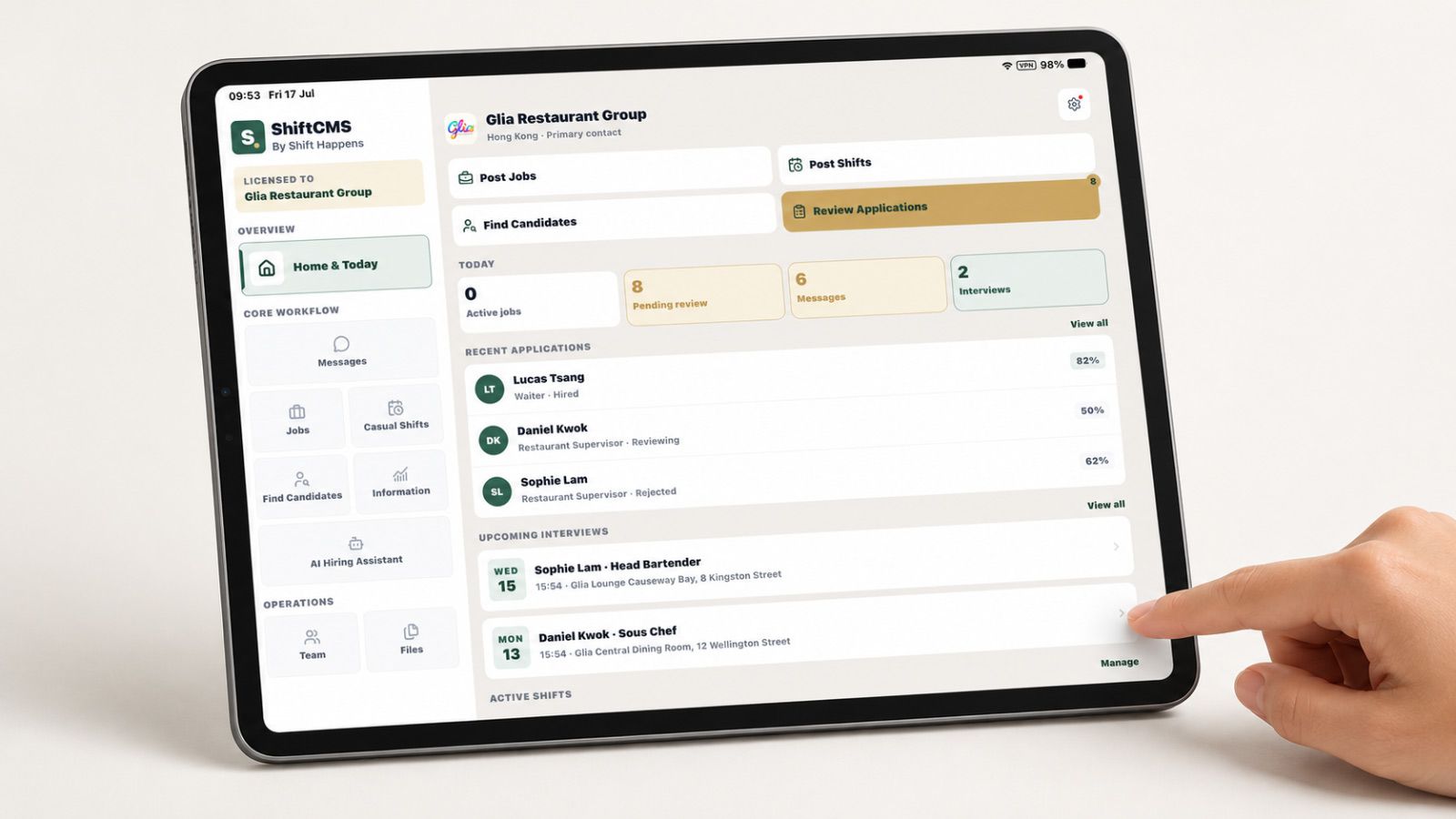
Smart Import lets an employer bring an existing listing into Shift Happens in seconds rather than rekeying it. If a role is already live on a major Hong Kong job board or an international platform, the employer can paste the listing text or provide the URL. The system extracts title, department, salary range, employment type, experience level, language requirements, location, benefits and a cleaned-up description, mapping locations to Hong Kong districts and normalising salary formats. The form populates with every field editable before the employer publishes. For venues with several live listings, the hours saved on the first week alone are often the most visible return.
Smart Suggestions sits inside the posting form and offers contextual recommendations as the employer drafts. The panel draws on two sources. The first is the employer's own posting history: salary patterns, language requirements and benefits from previous roles. The second is AI-powered market analysis: recommended salary ranges for the role and venue type, suggested language requirements based on the location, appropriate experience levels, and specific tips to make the listing more attractive to candidates. Each suggestion comes with a brief explanation of the reasoning, and the employer can apply any of them with a single click. Nothing auto-fills; the employer always makes the final call.
Candidate Search lets Business and Enterprise tier subscribers go directly to the candidate database rather than waiting for applications to arrive. Searches filter by district preference, experience level, language proficiency, department and availability. Results display candidate profiles with engagement indicators, and searches can be saved and re-run as the pool grows. For venues with a harder-to-fill vacancy, such as a pastry chef, a specialist bartender, or a head of service for a new opening, proactive search has historically been the preserve of agency partnerships. Having it in-platform and subscription-priced changes the economics.
Jeff Alam, CEO of Shift Happens, frames the shift this way:
"Hong Kong's hospitality sector has been clear about what it needs. Venues want the right people without spending half a manager's week on listings and shortlists, and candidates want to be seen for the experience they actually have. The tools we have rolled out speak to both sides of that equation, and the early feedback from operators is that they are getting meaningful time back for the parts of the job that need a human in the room."
The candidate layer that raises the quality of your queue
An employer's experience of recruitment is shaped almost entirely by the quality of the applications that land in the queue. Most of the manual hours a hiring manager loses go to variance on the candidate side: profiles that are half-filled, applications that are clearly generic, and interviews with candidates who arrive without having prepared. Four candidate-side AI features are designed to reduce that variance before the application ever reaches the employer.
CV Extraction handles candidate onboarding. A candidate uploads a PDF or Word CV, and the system reads the document and populates their profile with structured data: work history, education, skills, certifications, language proficiency and career preferences. The extraction understands both English and Traditional Chinese CVs, maps skills to the platform's canonical hospitality list, and recognises Hong Kong-specific qualifications such as WSET levels and Food Safety certifications. The candidate reviews the results in a side-by-side comparison and approves what gets kept. The process typically takes a candidate from sign-up to a searchable profile in under two minutes.
Profile Analysis gives candidates a practical read on their own profile before they apply anywhere. The analyser evaluates experience quality and progression, skills breadth and market demand, language proficiency, relevant certifications, and overall profile completeness, producing a letter grade, category-level scores and specific improvement suggestions tuned to Hong Kong hospitality roles. The output is downloadable as a branded PDF, which gives the candidate a reference document and reinforces the standard they are being measured against.
Application Writer generates a cover letter tailored to the specific role and venue, drawing on the candidate's work history, skills and certifications rather than producing a generic template. The candidate edits the letter before submitting, and the AI-generated status is transparent throughout. The intent is not to write the application for the candidate. It is to help a strong candidate articulate why they fit, using specifics the employer actually cares about.
Interview Preparation closes the loop. Once an interview is scheduled, the candidate gets role-specific likely questions with suggested answer frameworks, talking points linking their own experience to the job requirements, a company research summary drawn from the employer's profile, questions to ask the interviewer, and a practical preparation checklist. The content is Hong Kong hospitality-specific: service scenarios, team management situations, local employment terms, and dress code expectations relevant to the venue type.
For an employer, the value of this layer is indirect but substantial. Complete profiles take less time to read. Applications grounded in real experience are easier to act on. Prepared interviewees produce cleaner interviews and better hiring decisions. Marcus Treamer, Chief Product Officer at Shift Happens, puts the brief like this:
"The brief we set ourselves was to lift the quality of every application an employer sees. When a candidate arrives on the platform, the system helps them build a complete profile from a CV in under two minutes, shows them where their profile is weak against Hong Kong hospitality standards, and helps them write an application grounded in their actual experience. The result is a queue of candidates that is genuinely easier for employers to act on, in English or Traditional Chinese depending on how the candidate prefers to work."
Bilingual by design, free through 31 May
Every one of the nine features works in English and Traditional Chinese end to end. A Cantonese-first candidate can have their CV extracted from a Chinese document, get their profile analysis in Chinese, write an application in Chinese, and prepare for an interview in Chinese. An employer can post a bilingual listing with suggestions in either language and review bilingual applications in a single queue. This bilingual parity is not a retrofit. The features were designed for Hong Kong's hiring reality from the outset, running on Anthropic's Claude models, chosen for their strong performance with Traditional Chinese and for the professional context hospitality recruitment demands.
The full suite is free to all users during the beta window that runs to 31 May 2026. After the beta period, access follows the existing subscription structure: the candidate premium tier at HK$88 per month, the employer Professional tier at HK$1,500 per month, and the employer Business tier at HK$3,500 per month. Candidate Search is exclusive to Business and Enterprise tier employers. The beta window is intended to give Hong Kong venues six weeks to build the AI features into their routine hiring process without commercial commitment.
There is one further tool operating in the background. Behavioural intelligence observes signals from actual platform use (jobs viewed, jobs saved, applications submitted and search patterns) and infers career preferences that feed into the matching algorithm. The effect is compounding rather than immediate. The more a venue and its candidates use the platform, the sharper the recommendations and the candidate ranking become. The features described above work from day one; the behavioural layer is what will make them better in three months than they are today.
The next six weeks
Hong Kong hospitality is not short on effort. Operators have absorbed pandemic disruption, wage adjustments, service charge scrutiny, a new continuous-employment rule, and the usual pressure of running a venue in one of the world's most competitive dining and drinking markets. The part of the operation that has been least amenable to efficiency gains is recruitment, because it has historically required a human reading every CV, writing every listing from scratch, and preparing for every interview in isolation.
That is what this rollout changes. The nine features described here do not replace the hiring manager's judgement. They remove the repetitive drafting, extraction and summarisation that has been consuming the hours around that judgement. The manager still chooses who to hire. They simply get to that decision faster, with a better-prepared shortlist, in either language the candidate speaks.
The beta window closes on 31 May 2026. Between now and then, the recommendation to any venue operator reading this is simple. Bring one or two of your next hires onto the platform, post a role using Smart Import and Smart Suggestions, run Candidate Search if you are on the Business tier, and compare the hours against what the same hire took a quarter ago. That comparison is the only honest benchmark, and the beta period is specifically sized to give you time to run it.
If you run a Hong Kong F&B venue and you want to see the full suite in action, the fastest route is to start with a posting. The employer flow at shifthappens.app/en-hk/for-businesses walks through Smart Import and Smart Suggestions, and a conversation with our team can cover Candidate Search and the subscription tiers that apply after 31 May. Every feature described in this article is live on the platform today.