
When Venue-by-Venue Hiring Stops Working
Opening a second venue is supposed to be the proof that the first one worked. For many Hong Kong restaurant groups, though, it is also the moment when the hiring process quietly falls apart. The job postings that worked perfectly for one site get duplicated and edited inconsistently across locations. The candidate who would have been ideal for the Wan Chai venue never surfaces because they applied to the Central listing. The owner, who used to know every applicant personally, now relies on two site managers who each see half the picture, and neither sees the whole one.
The numbers make this tangible. Hong Kong’s hospitality sector runs at a staff turnover rate that routinely exceeds 30 per cent, and by some measures sits between 67 and 74 per cent annually for the broader industry. At that velocity, a five-venue group is effectively running five to seven concurrent, continuous recruitment campaigns at any given time. When each of those campaigns operates in its own silo, with its own job postings, its own applicant pipeline, and its own ad hoc record-keeping, every new site multiplies the problem rather than sharing the workload.
There is also a Hong Kong-specific dimension that makes fragmented hiring riskier than it might appear. The Employment Ordinance requires employers to maintain wage and employment records at the place of business or at the place where the employee works, and failure to do so carries a fine of HK$10,000 per breach. For a group running five venues with five independent hiring workflows and no centralised record of who was offered what, where, and when, the compliance surface area grows with every location. That risk tends to stay invisible until an inspection brings it to the surface.
We built Outlets because our employers told us, in terms that were difficult to misunderstand, that this was the problem they needed solved next. And once we started building it, we realised just how much of the platform it would improve.
What Our Employers Actually Asked For
The conversations that led to Outlets came from two directions. Existing employers on the platform who were planning to open a second venue wanted to know whether Shift Happens could handle both locations from a single account. And prospective customers already operating multiple sites wanted to know whether a site manager could see only their own venue’s applicants, without the rest of the group’s hiring activity appearing on their screen.
Different situations, but the same underlying need. They wanted one system that could separate hiring by location, give each venue manager exactly the right level of access, and still let the owner or HR lead see everything in one place. Nobody wanted to manage three venues through three separate accounts. And nobody wanted every team member seeing every applicant across the entire group.
We could have built a minimal version of this. A location tag on job postings and a filter on the dashboard would have solved the visibility problem. But it would have ignored the permissions problem, the template problem, and the compliance problem. So we did something more ambitious: we built a complete venue layer that sits underneath the employer account and touches every part of the recruitment workflow, from job postings and shifts through to team access, candidate pipelines, favourites, and reporting.
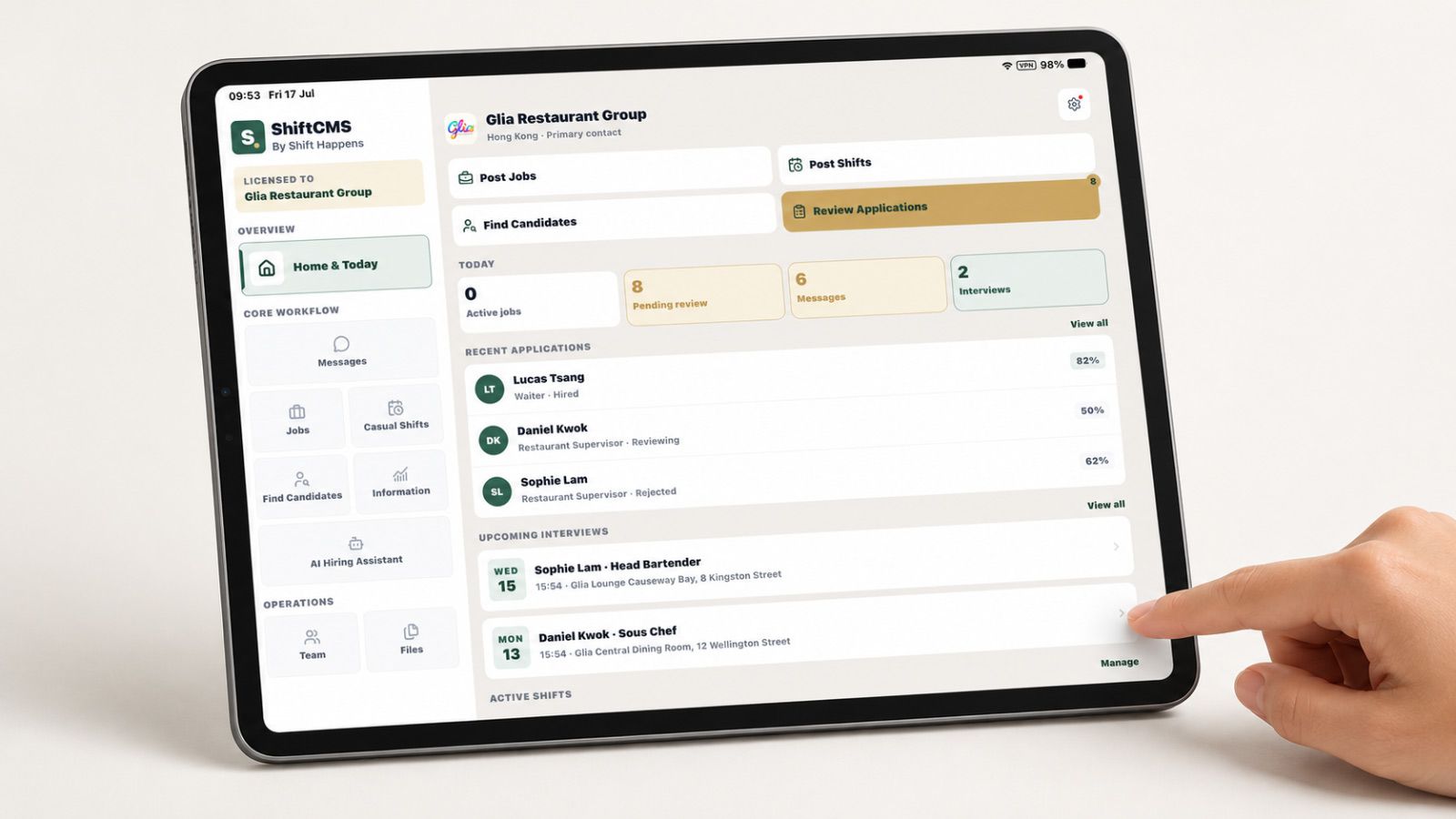
The feature is live on the web platform now. Not a beta, not a preview. Multi-venue management on the ShiftCMS mobile app ships separately as version 1.1.0, and the mobile launch article covers the broader ShiftCMS story for anyone who has not read it.
How Multi-Venue Management Works
An employer account on Shift Happens now represents an organisation, not a single address. Each physical location sits as a venue underneath that account, with its own name, address, district, venue type, contact details, logo, and photo, all stored in both English and Traditional Chinese. A group with three venues sees three distinct locations under one login, each with its own identity and its own hiring activity. One account, one set of credentials, the full picture.
Team permissions are where this gets really interesting for operators. A team member can be set to access all venues or scoped to specific locations. A site manager in Wan Chai sees the jobs, shifts, applicants, and direct offers for Wan Chai only; head office retains the full account-wide view. The primary contact is locked to all-venue access and cannot be scoped down, which means an account can never accidentally lock itself out. When you invite a new team member, you choose their venue scope at the point of invitation, so their access is correct from their very first login rather than being fixed up after the fact.
Job postings are assigned to a primary venue, and permanent roles can be posted across multiple venues at once. A group hiring servers for Central, Wan Chai, and Causeway Bay posts one job rather than three, manages all applicants in a single pipeline, and each venue appears on the listing so candidates know exactly where the role is based. Shifts remain single-venue, because a shift happens at one place at one time, but shift templates can be duplicated from one venue to another. When a group opens a new site, copying the existing venue’s template library means the new location is ready to go from day one rather than being rebuilt from scratch.
There is more beneath the surface. Casual workers who perform well at a particular venue can be tagged as favourites for that location and surface first when it needs cover. Reporting groups activity by venue, and scoped managers see only their own data in filters and results. The employer’s public profile page shows each active venue to candidates, so a group’s full footprint is visible to anyone browsing. Every part of the platform knows about venues now, and that makes a real difference to how the whole system feels when you are managing more than one site.
Built for How Hong Kong Hospitality Actually Operates
We did not build this in the abstract. Hong Kong’s food and beverage sector has specific characteristics that shaped every decision we made, and getting those right was as important to us as the feature set itself.
Start with geography. A restaurant group in Hong Kong might operate venues in Central, Wan Chai, and Causeway Bay, all within a few MTR stops of one another. That proximity makes candidate pooling across venues genuinely practical. A server who applies for a role in Wan Chai and does not get it might be exactly right for the same group’s venue in Central, with a commute difference of ten minutes. In a market where 18,000 venues compete for the same limited talent pool, losing a qualified candidate because they applied to the wrong branch is a cost no group should have to bear. Pooling candidates at the group level, rather than siloing them by location, is one of the things we are most pleased about in this release.
Then there is language. Every venue on Shift Happens carries its name, address, and district in both English and Traditional Chinese. When a job posting spans multiple venues, each location renders correctly in both languages on the candidate-facing listing. This matters more than it might seem. A significant share of Hong Kong’s hospitality workforce searches and applies in Chinese, and a listing that shows a venue address only in English is effectively invisible to part of the candidate pool. We wanted to make sure that never happens on our platform.
And finally, compliance. Hong Kong’s Employment Ordinance imposes record-keeping obligations tied to the place of work, not the employer’s head office. A centralised hiring system that tracks which candidates were contacted, interviewed, offered, and employed at which venue creates a group-level compliance record that venue-by-venue hiring simply cannot produce. For operators managing three or more sites, that structural advantage becomes very real at the point of a Labour Department inspection.
One Account That Grows With You
From the beginning, our mission at Shift Happens has been to reduce the friction between head office and the venue floor when it comes to hiring. Too much of hospitality recruitment still runs on disconnected tools, duplicated effort, and information that sits with one person in one location. Outlets is the most direct expression of that mission so far, and building it has been one of the most rewarding parts of the platform’s development: a single account that gives head office full visibility, gives each venue manager exactly what they need, and removes the administrative overhead that accumulates with every new site.
The pricing reflects this philosophy. Venue allowance is tied to the subscription tier, not charged per venue. Basic includes one venue, Professional includes three, Business includes ten, and Enterprise is unlimited. An account that exceeds its tier by one venue gets a 90-day grace period to upgrade or consolidate, with no overage charge during that window. We designed the upgrade path to follow natural expansion milestones rather than penalise growth. When an operator opens their fourth site and moves from Professional to Business, the system is already set up for the next six.
For single-site operators, nothing changes. The venue layer stays hidden for accounts with one location, so the interface adds no complexity for the majority of users. The feature activates the moment an operator adds their second venue, and not before. The same account they created on day one carries them from one venue to ten without a migration, without a second login, and without losing any of their existing data, team, or candidate history. That continuity matters to us, and it should matter to anyone choosing a platform they intend to grow with.
Outlets is a big step for Shift Happens, but it is one part of a much larger picture. We are building a true end-to-end recruitment platform for Hong Kong hospitality, and multi-venue management is a foundation that much of what comes next builds upon. The ShiftCMS mobile app brings the full venue feature set to iOS and Android in version 1.1.0, and there are more features in the pipeline that we are genuinely excited to share in the coming months. For groups already managing multiple sites, the web platform handles it today. For operators planning their next location, the system is ready when you are. You can register or sign in at shifthappens.app, and every account has full access to the Business tier at no cost during the current beta, which includes management of up to ten venues.