TLDR
A new field guide addresses what operators actually face on a working shift. The Shift Up collects 25 years of hospitality operations experience into 15 chapters of practical frameworks, financial tools, and staffing strategies designed for independent venues.
The book covers four pillars operators deal with every week. From concept stress-testing and capital raising through marketing, menu engineering, and beverage programme management to staffing retention and knowing when to close, each chapter carries specific numbers and named case studies.
Hong Kong's operating conditions run through the book. The market's landlord dynamics, regulatory shifts, and staffing pressures shaped many of the frameworks. Readers of the Shift Happens F&B Insights hub will recognise themes explored in published articles on the 468 rule, service charge economics, and workforce planning.
Every framework is built for execution, not presentation. Pour cost targets by category, replacement cost per employee by role, pricing formulas applicable to a live menu, and scoring thresholds with clear go/no-go cut-offs. The companion worksheets make each tool operational within existing systems.
The 2026 edition reflects how the industry has shifted. Chapters on AI-driven search visibility, the collapse of influencer marketing economics, the non-alcoholic business case, and four-day working week data address conditions that did not exist in this form two years ago.
Hong Kong's hospitality operators do not lack advice. Between industry conferences, consultant pitches, and trade press, the volume of guidance available to anyone running a venue in 2026 is considerable. What most of it shares is a careful distance from the floor: the decisions made during a real service, under real financial pressure, with the team you actually have.
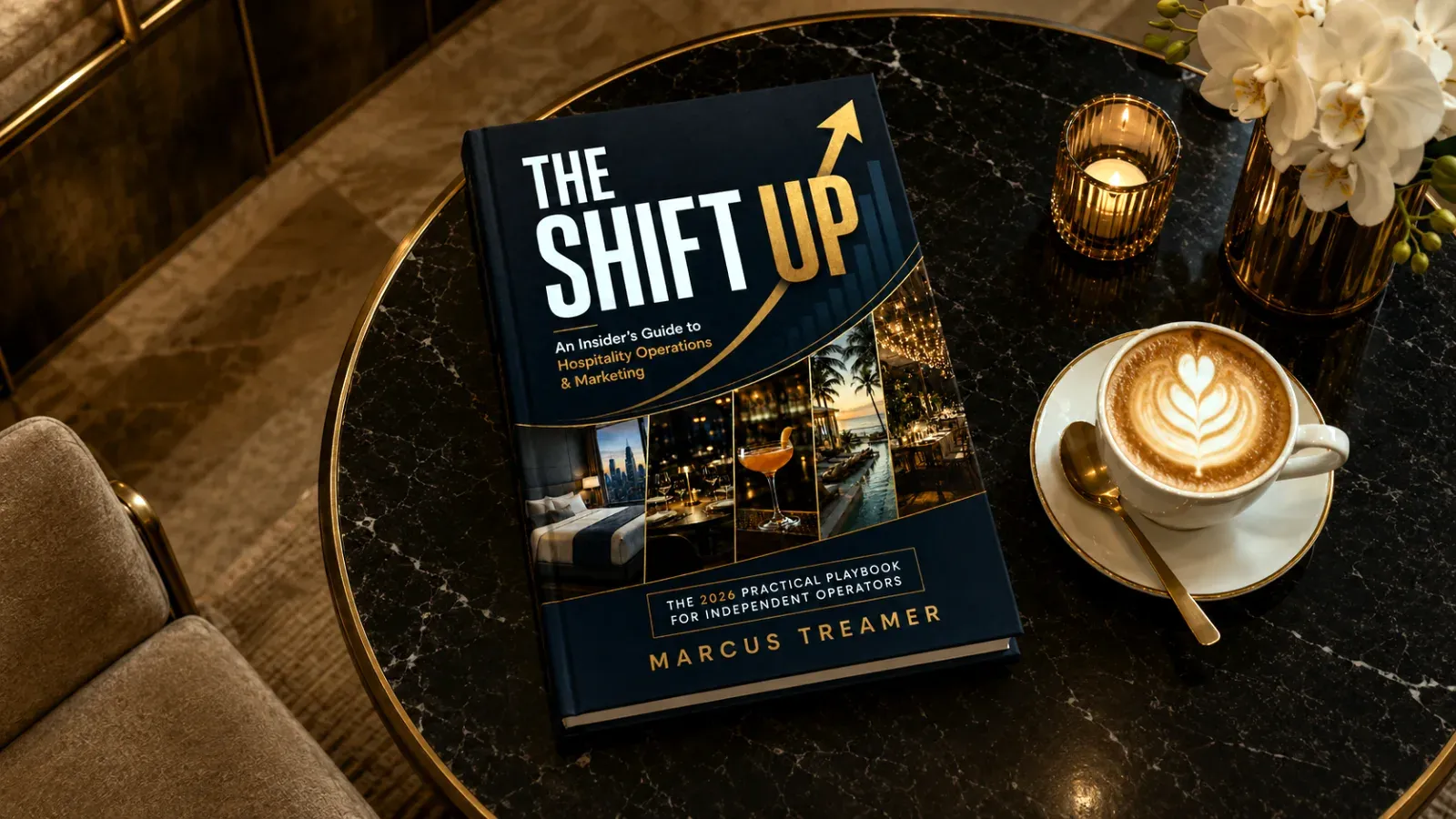
The Shift Up, a new field guide by Marcus Treamer, closes that distance. Structured around four operational pillars and 15 chapters, the guide assembles frameworks from 25 years of running hospitality businesses in Hong Kong, Shanghai, Dubai, Beijing, and Koh Samui. It calls itself a field guide rather than a textbook. The distinction is not branding. Every chapter contains working numbers, named case studies, and a tool designed to be applied before the next service, not filed after a conference.
Several of the themes will be familiar to readers of the Shift Happens F&B Insights hub. The 468 rule's implications for casual staffing, the structural economics of service charges, workforce planning under Hong Kong's regulatory conditions: these are subjects the Insights hub has covered in depth. The book places them inside a broader operational framework, connecting individual regulatory or financial questions to the full life cycle of a venue.
That life cycle is what the four pillars trace.
Foundations: concept and capital
The opening pillar deals with the two decisions that shape everything downstream. The first chapter covers concept development with an emphasis on stress-testing: how to determine whether a concept will survive market pressure, competitive imitation, and the operator's own impulse to dilute it over time. The second moves to capital raising, comparing structures and offering specific guidance on protecting creative control and intellectual property before accepting external investment.
What gives these chapters their weight is timing. The framework asks operators to run their concept through defined pressure tests before committing capital, not after the lease is signed. For anyone navigating Hong Kong's commercial rents, the distinction between a concept that survives a landlord negotiation and one that folds under it is worth examining well before month one.
Attention and acquisition: how guests find you in 2026
Six chapters cover marketing, guest acquisition, and reputation. The most current is the treatment of AI-driven search. Traditional SEO has given way to answer engines and recommendation systems that surface venues differently from the directory listings operators grew up with. Most marketing guidance has not caught up with this shift; Treamer's chapter addresses what operators need to do now to remain visible to the systems that increasingly determine where guests eat and drink.
Influencer marketing gets a direct assessment. The financial case against it for independents is laid out alongside a creator content alternative that costs less and produces more durable results. A separate chapter on social media works from a weekly time budget rather than an aspirational content calendar, a concession to the reality that venue operators are not running a marketing department. The reviews and reputation chapter connects response quality to the AI recommendation systems covered earlier and offers a fifteen-minute daily routine for managing the full cycle.
Running through these chapters is a tension Hong Kong operators know well: the cost of paid acquisition set against the economics of a venue on tight margins. The community-building chapter makes the argument that paid acquisition is economically broken for independents, and that retention through community replaces it.
Operational excellence: the numbers that matter on the floor
The third pillar is where the field guide earns its name. Menu engineering, beverage programme management, staffing, and revenue diversification each receive a full chapter with operational tools attached.
Menu engineering goes beyond the classic matrix into pricing psychology and the evidence around descriptive language, which the guide reports can increase item sales by up to 27 per cent. The beverage chapter breaks pour cost management down by category, includes a sliding scale for wine by the glass, examines the non-alcoholic business case, and maps out a 90-day programme refresh cycle.
The staffing chapter connects most directly to the Shift Happens platform. It addresses the structural deficit facing Hong Kong's hospitality sector, the economics of staff replacement by role, and the emerging data on four-day working weeks. It also examines the threshold for gig labour integration, placed at roughly 10 per cent of total hours. Readers who have followed the Insights hub's coverage of the 468 rule amendment and minimum wage changes will find the broader workforce planning argument those articles belong to.
Revenue diversification rounds out the pillar with a scoring framework for evaluating private events, corporate catering, retail lines, and subscription models. The framework's value is less in listing the options than in defining the point at which diversification becomes dilution.
Strategic intelligence: reading the market and knowing when to stop
The final pillar addresses two subjects most hospitality books avoid entirely. The market intelligence chapter distinguishes structural shifts from temporary trends and includes guidance on evaluating consultant advice, a subject rarely covered from the operator's side of the table.
The closing chapter, on knowing when to evolve, hold, or close, is the most unusual in the book. It offers a hold-or-fold assessment for struggling venues alongside the mechanics of managed closure: how to wind down an operation in a way that preserves reputation, relationships, and the foundations for whatever comes next. The industry rarely discusses closure as a managed process. It is treated as a failure rather than a decision, and the chapter fills that silence with practical specificity.
From insights hub to field guide
The Shift Happens F&B Insights hub has covered individual topics in depth over the past year: workforce regulation, salary benchmarking, mental health in hospitality, the 468 rule. What those articles share with The Shift Up is a conviction that hospitality professionals are better served by specific, verifiable guidance than by abstract strategy. The book assembles those individual threads into a single operational framework that runs from concept to closure.
Its international scope extends the range. Case studies draw from venues as varied as Shake Shack, Alinea, Dishoom, and beach clubs in Koh Samui, whilst maintaining the operational specificity the Insights hub's readers expect. The guide is not a Hong Kong book, but Hong Kong's operating conditions shaped its thinking, and operators here will recognise the pressures it describes.
The Shift Up is available now in PDF and EPUB formats at $9.99, including 19 companion worksheets, and as a seven-and-a-half-hour audiobook at the same price. A free sample is available at maketheshiftup.com.
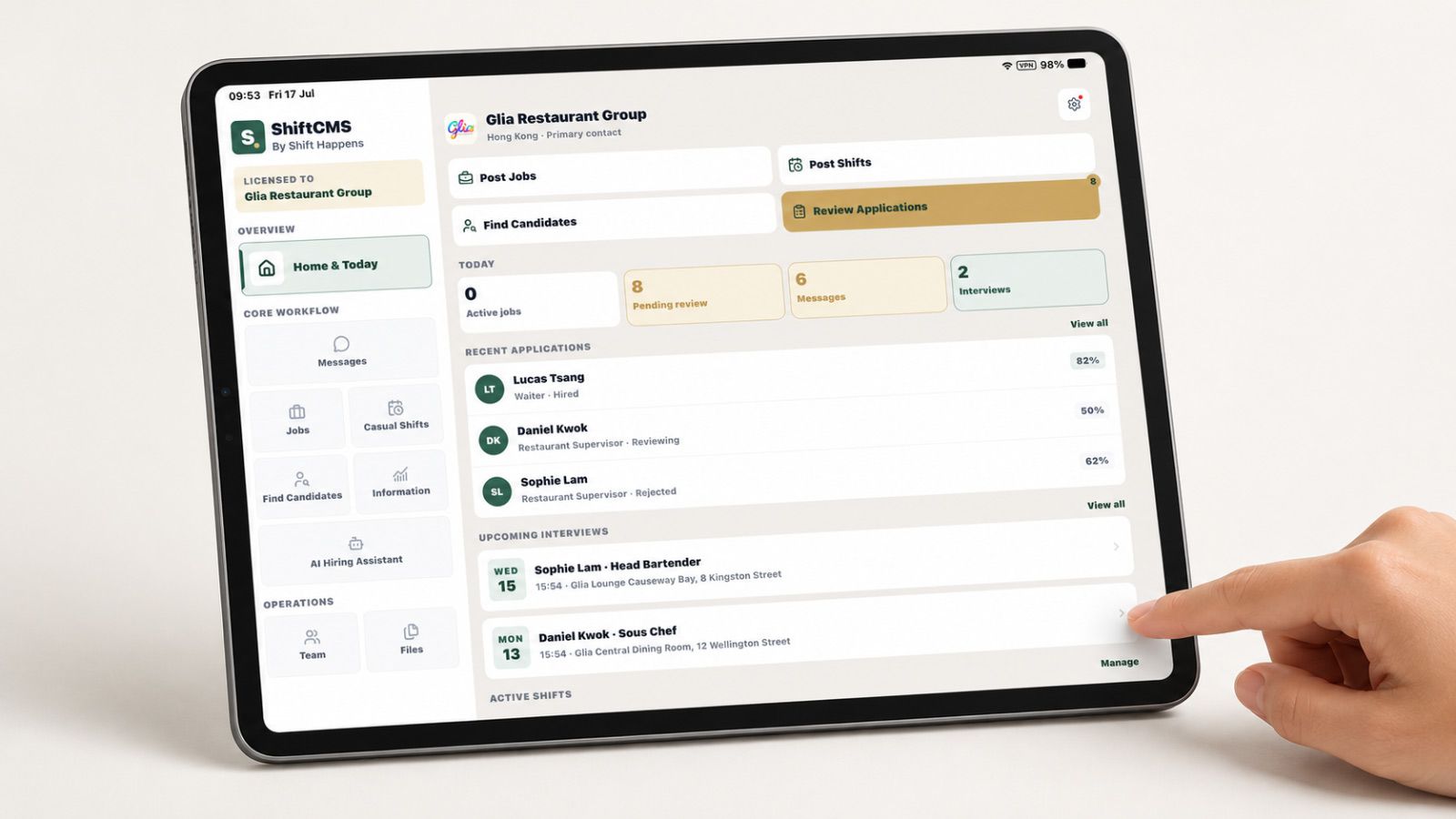
For operators ready to connect these frameworks to Hong Kong's recruitment landscape, the Shift Happens platform offers the staffing infrastructure the guide's workforce chapters describe. Browse current hospitality positions at shifthappens.app, or explore the full archive of industry analysis on the F&B Insights hub.